Getting attention with the right people is the game.
Iteration is the system.
The way to win: daily trendline data, iteration on winners, broad pools with strong purchase signal, and backend sales as the only ROAS truth.
Book a strategy call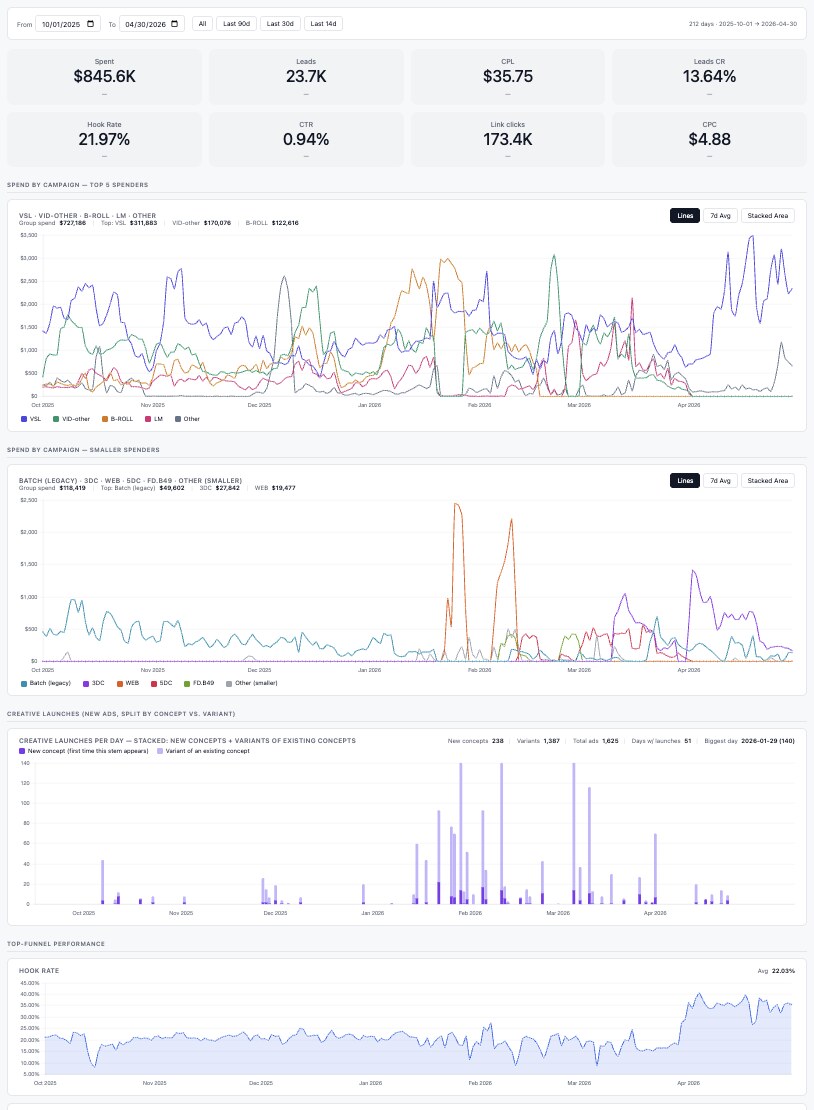

Your Meta Ads account is stuck.
You're spending real money. The team is busy. But scale won't come, performance swings unpredictably, and no one can tell you exactly why.
- There's a never ending need for "more creatives" but nothing is cumulating. The wins aren't compounding or translating to overall results.
- Performance swings hard and no one can explain the swings beyond "the algorithm" or "CPMs."
- Platform ROAS looks fine, but your backend numbers tell a different story.
- Every time you push spend up, performance breaks. So spend is stuck.
- Reports are full of metrics but you still can't answer "what's the path to success?"
What every strong Meta Ads account is built on.
There's no clever tactic that fixes a broken foundation. These five things have to be true before iteration matters.
An offer people want.
Ads that work.
- i.Grab attention
- ii.Engage
- iii.Demonstrate unique value
Ads shown to the right people.
A funnel that builds value beyond the price.
A smooth purchase process.
Beyond this, Meta Ads accounts need an iterative and diversified ad creative testing process. Our approach to creative strategy and testing lives here →
It's also important to know how to work with Advantage+ and Andromeda, without giving over 100% of the reins to Meta just yet.
A weekly assembly line for ad creative.
Iteration and diversification only compound when the system underneath runs on a schedule. The full breakdown is on the creative strategy, but here's the shape of it.
- 01 Performance Report
- 02 WHY hypotheses formed
- 03 Iteration briefs
- 04 Diversification briefs
- 05 Assets
- 06 Editors · Designers
- 07 Approval · Edits
- 08 Media team launch
- 09 Test Period
What the engine produces.
A glimpse of what the assembly line ships, week over week.
Lifestyle UGC
Social-native iteration
Practitioner UGC
How we run Meta Ads.
These are the five things every Meta account should be doing. Most aren't. Each one fixes a different way the account leaks money.
Trendline data over averages.
Averages hide the truth. The algorithm is prioritizing or deprioritizing you day over day, and a weekly average flattens that. We track daily trendlines on hook rate, CPM, CPL, and backend ROAS, so when the algorithm shifts, we see it within 2 to 3 days, long before it shows up in ROAS.
Waterfall optimization.
Most people optimize their ad account based on the "north star" metric, usually ROAS, CPA, or CPL. That should be the waterfall base. But if someone never even stops scrolling to view your ad, they won't have the opportunity to buy. If they never click, they won't have the opportunity to buy. So we benchmark 2 to 3 upstream metrics against the north star, figure out their correlations, and optimize accordingly. This usually improves performance 10 to 20% over time.
Iteration on winners, not new ads every week.
"More creative" is not a creative strategy. Iteration plus diversification is. Why an ad won is more important than what won, so the next ten ads should be hypotheses about why, not random new concepts. The system runs both lanes at once: iteration on top performers compounding the wins, and fresh concepts in parallel for diversification, on a real schedule.
Broad pools with strong purchase signal.
"Broad" sounds like watered down targeting, but that's only true if it's not set up with strong purchase signal. Broad targeting has to be paired with strong purchase events, pointing the algorithm at the right people. The signal does the targeting, from inside the pool. It's important not to fight the algorithm with narrow segments and starve it of the data it needs to optimize.
Backend sales data, not platform attribution.
Meta will tell you every purchase it was involved in, but that doesn't help you understand incrementality. Real ROAS lives in your sales data, your CRM, your backend. Every decision we make is against the backend numbers, not the platform's claim. When Meta says we did $400K and the bank says we did $200K, we trust the bank.
A real strategy, and process.
The work happens on a real schedule. Here's what each cadence actually looks like.
Week 01
Audit + Dashboards
- Full account audit
- Backend data plumbing
- Creative Fatigue Dashboard built
- Customer Flow Dashboard built
- Success metric agreed upfront
Weekly
Iteration cycles
- Waterfall optimization benchmarks setup
- Trendline review
- Iteration briefs to creative team
- Budget reallocation
- Net-new concept queue
Monthly
Retro + plan
- MER and backend ROAS review
- Hypothesis retro
- Channel-mix decisions
- Next-month plan
- Stakeholder readout
Day 90
Decision point
- Goal review against agreed metric
- Honest read on fit
- Continue, evolve, or part ways
- No auto-renew pressure
The dashboard that watches your creative for you.
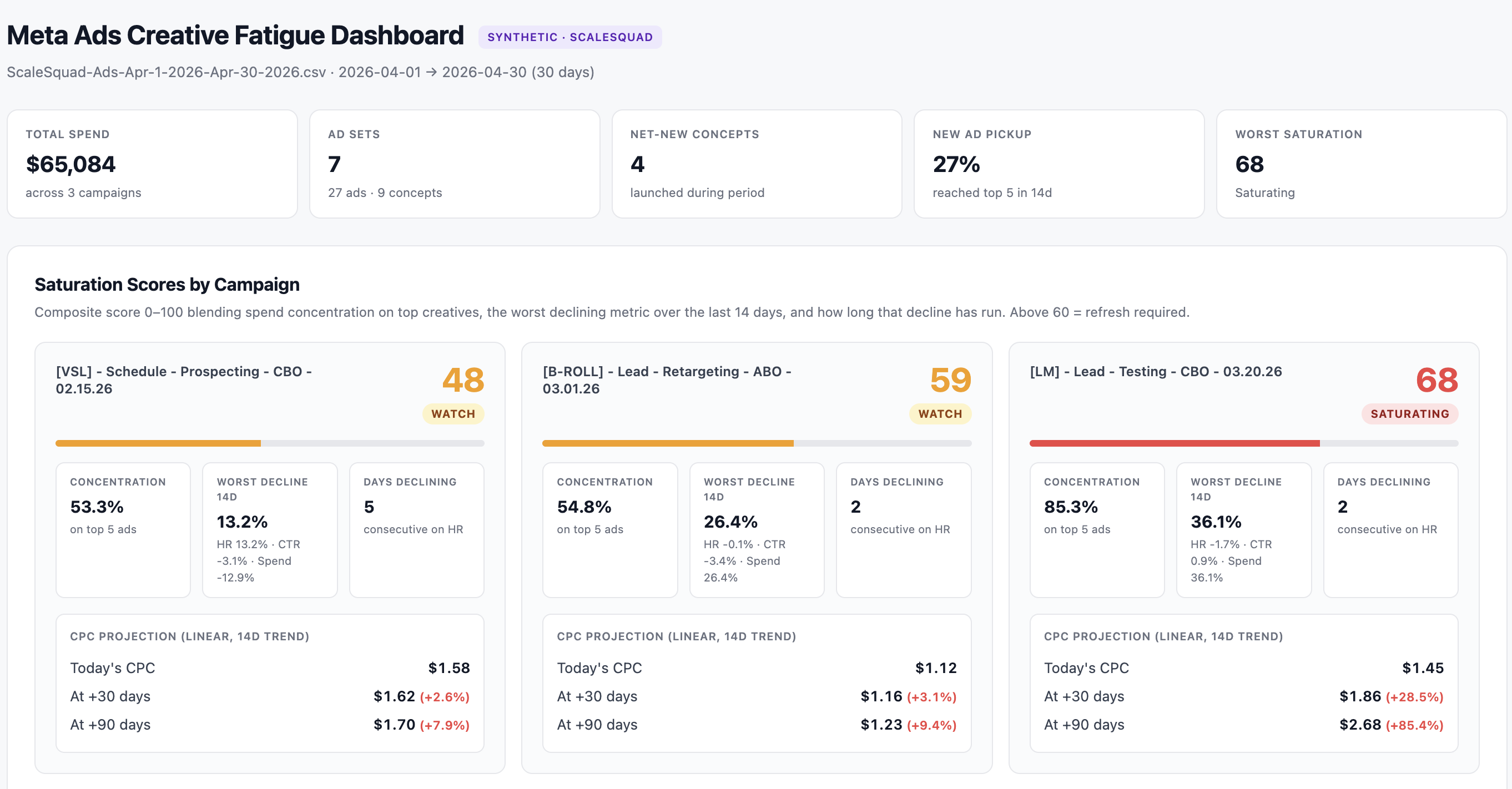
Every Meta engagement starts with the Creative Fatigue Dashboard. You stop guessing or worrying whether ads are saturating, because the dashboard tells you. What's monitored can be proactively managed.
Creative Fatigue Dashboard
Saturation scores, spend share by ad, top spending ads change tracker, and trendlines on hook rate, CTR, and CPC. You see the warning signs of saturation before performance breaks.
- Hook rate trend per ad, week over week
- Spend share concentration tracker
- Launch frequency + test ads spend pickup trendlines
- Iteration queue, sorted by what's earned the next slot
Real account. Real numbers.
Lifted Top-of-Funnel Meta ROAS 53% in six months, while monthly Bookings climbed 24%.
Inherited the Top-of-Funnel Meta acquisition account at a 12-month ROAS floor. The fix was a creative engine, not a creative refresh. We pivoted UGC to trainer storytelling (real stories, real specifics), built an iteration system that lifted monthly evergreen launches from ~24 to ~76 per month, and rendered top-converting Google search terms directly into Meta videos so the channels primed each other.
Hook rate climbed above the prior baseline by March and peaked at 28.1% in April. AOV moved up 12%. Total account ROAS (Meta plus Google plus TikTok) rose from 2.01 to 2.57, confirming the Meta gain was real lift, not credit shifting between channels.
Read the full case study →Two ways to work together.
The Performance
Sprint
- Defined success metric agreed upfront
- Full Meta account audit + 90-day plan
- Creative Fatigue Dashboard built in week one
- Weekly iteration cycles on creative & spend
- Direct access to senior strategy, no junior handoff
The 12-Month
Partnership
- Everything in the Performance Sprint, sustained
- Senior strategy inputs + AI-scaled outputs
- Creative production at agency volume
- Ongoing dashboard evolution
- Quarterly business reviews
Best fit: brands spending $30K/mo+ on Meta, with a high AOV or LTV.

Want Meta to actually compound instead of treadmilling?
One 30-minute call. Honest read on what's broken, what's salvageable, and whether we're a fit. No pitch deck.
Book a strategy call